Choosing the best China SPC Herringbone Flooring requires more than comparing photographs or factory prices. A convincing product must combine stable construction, accurate geometry, safe materials, and dependable service. The herringbone pattern is visually demanding. Small dimensional errors can disturb the entire room.
In practical flooring evaluations, I would inspect the rigid core, wear layer, click-lock system, and surface finish. A reliable SPC plank should feel firm underfoot, while its locking edges should connect without excessive force. Samples should be tested in realistic conditions, including temperature changes, moisture exposure, and repeated installation. Check the plank thickness, wear-layer specification, and reported formaldehyde performance. Ask for independent test documents, not only marketing claims. Details matter here.
Design also deserves careful attention. Warm oak tones can soften a narrow hallway, while deeper walnut shades create stronger contrast around furniture. The bevel, embossing, and matte texture should look natural under both daylight and warm lamps. However, “best” does not mean perfect. Some products may offer attractive textures but limited color consistency between batches. Others may have excellent locking systems but fewer reliable accessories. That weakness should be acknowledged.
This guide compares Chinese SPC flooring options through measurable quality, installation experience, design flexibility, and supplier credibility. It considers how the flooring performs after real use, not merely how it appears in a showroom. Buyers should still verify current specifications, certifications, and warranty terms before ordering. A careful decision begins with evidence. Looks alone are not enough.
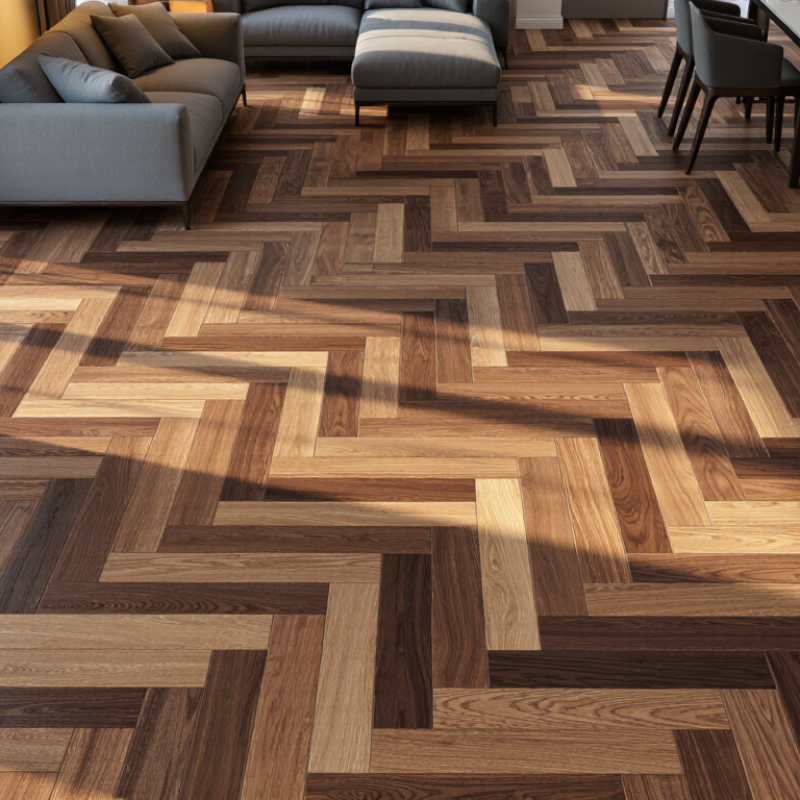
SPC herringbone flooring is a rigid-core floor made from stone powder and polymer. Its structure gives boards strong dimensional stability. The herringbone layout creates a refined, directional pattern. It can make a narrow room feel more organized and visually spacious. Unlike solid wood, SPC flooring resists everyday moisture and temperature changes more effectively. However, “waterproof” does not mean the subfloor can stay wet.
The best China SPC herringbone flooring should combine accurate cutting, stable locking systems, and a reliable wear layer. During installation, even small size differences can disturb the zigzag pattern. A level subfloor is essential. Dust, dips, or movement may cause gaps and clicking sounds. Check product samples under natural light. Review thickness, abrasion data, formaldehyde testing, and installation instructions. Factory quality records also matter. A low price may hide inconsistent batches.
Tips: Order extra planks for future repairs. Keep cartons flat in a dry room before installation. Follow the supplier’s acclimation guidance. Use a professional installer for complex rooms, doorways, and large open areas. No floor is perfect. Glossy surfaces may show scratches sooner, while deeply textured finishes can collect dust. This trade-off deserves attention before choosing a pattern.
China SPC herringbone flooring begins with a carefully balanced core. Limestone powder, polyvinyl chloride, and stabilizers are mixed under controlled conditions. Heat then fuses the mixture into a dense, waterproof board. This core gives the flooring dimensional stability, but it is not completely immune to movement. Temperature changes still matter.
The surface is built in layers. A transparent wear layer protects the printed wood pattern from daily abrasion. A UV coating improves color stability and reduces surface fading. Manufacturers press these layers together under measured heat and pressure. The board is then cooled slowly to limit internal stress. Small errors here can cause curling later.
After lamination, precise cutting creates the herringbone pieces. Their angled ends must match closely, or the pattern will look uneven across the room. Click profiles are milled along the edges for faster installation. Quality teams check thickness, locking strength, surface texture, and color consistency. I have found that visual inspection alone is not enough. Calipers and repeated joint tests reveal problems that lighting can hide. No production line is flawless. Responsible factories should record defects instead of quietly passing them forward. The best product is not simply the thickest one. It is flooring made with stable materials, accurate profiles, and honest quality control.
The best China SPC herringbone flooring combines visual precision with dependable daily performance. Its stone plastic composite core should resist swelling when exposed to occasional moisture, while maintaining stable dimensions across seasonal temperature changes. A dense wear layer helps protect the surface from chair movement, grit, and busy household traffic. However, thicker is not automatically better. Core density, locking accuracy, and production consistency matter just as much.
The herringbone pattern demands careful manufacturing. Each plank should have clean edges, accurate angles, and a reliable click-lock system. Small size differences can create visible gaps across a large floor. A realistic wood texture, low-gloss finish, and varied plank shades can make the installation feel less repetitive.
I would also check slip resistance, surface abrasion results, formaldehyde emissions, and batch inspection records before ordering. Ask for samples.
Installation conditions deserve attention.
The subfloor must be clean, dry, and reasonably level. Uneven areas may cause movement or clicking sounds later. An experienced installer should leave expansion gaps around walls, cabinets, and door frames. Even quality flooring can fail when rushed.
I have found that color samples sometimes look different under warehouse lights, so viewing them beside a window is wiser. “Waterproof” also needs careful interpretation; standing water can still reach joints if spills remain unattended.
The best option is not always the thickest plank. Compare construction, testing, and installation performance. Grand View Research’s 2024 luxury vinyl tile report identifies continued high-single-digit market growth through 2030. That growth reflects demand for durable, water-resistant flooring, but it does not guarantee equal quality. Check the SPC core thickness, usually measured in millimeters, and inspect the wear layer. A 0.5 mm wear layer suits heavier residential traffic better than a thinner layer. Ask for technical sheets, not only attractive samples.
Look closely at the herringbone locking system. Small dimensional errors become visible across a large floor. Request tolerance data, click-cycle testing, and installation instructions. ASTM F3261 covers luxury vinyl tile installation practices, while ISO 10582 addresses heterogeneous PVC floor coverings. These references help, but factory testing may still vary. Confirm slip resistance, surface abrasion results, formaldehyde emissions, and batch consistency. A sample can look perfect. The carton may differ.
Tips:
Compare three samples under daylight. Measure plank length, thickness, and squareness. Check the back for uneven backing. Ask whether the quoted price includes matching moldings, underlayment, and replacement pieces. Review the warranty carefully; vague wording deserves caution. I would also test two joined planks by hand. If the seam opens easily, the product may need better quality control or a more careful installer.
When evaluating the best China SPC herringbone flooring, installation quality matters as much as the product itself. Begin with a firm, clean, and level subfloor. Remove dust, loose particles, and old adhesive. Uneven areas can create movement, clicking sounds, or open joints later. Check moisture levels before installation, especially on concrete floors. Follow the flooring manufacturer’s limits carefully.
Let the planks adjust to the room’s temperature as directed. Plan the centerline before laying the first herringbone row. This pattern exposes small errors quickly. Keep the angle consistent, and leave the required expansion gap around walls, cabinets, and door frames. Use spacers during installation. Even experienced installers sometimes rush this step. That mistake can cause buckling months later. Cut around door frames carefully for a cleaner finish.
Tips: Sweep with a soft broom each day. Wipe spills quickly. Use a slightly damp mop and a pH-neutral cleaner. Avoid soaking the floor. Place felt pads under furniture legs, and use entrance mats near exterior doors. Do not drag heavy cabinets across the surface. A steam mop may seem convenient, but heat and moisture can damage joints. Inspect the floor every few months. Small gaps are easier to address early.
| Category | Evaluation Dimension | Recommended Specification or Practice | Installation and Maintenance Guidance |
|---|---|---|---|
| Product Selection | Overall plank thickness | Approximately 4–8 mm, including the wear layer and attached underlay where applicable. | Select thickness according to subfloor flatness, door clearance, room traffic, and transition heights. Confirm the complete build-up before installation. |
| Product Selection | Wear-layer thickness | About 0.30 mm for normal residential use; 0.50 mm or more for busy homes and light commercial applications. | A thicker wear layer generally provides better resistance to abrasion. It does not eliminate the need for entrance mats and furniture protection. |
| Product Selection | Surface finish | A textured, low-gloss polyurethane or ceramic-bead finish with a realistic wood-grain embossing. | Choose a moderate texture that improves slip resistance without making sweeping and damp mopping difficult. |
| Product Selection | Core construction | A dense, dimensionally stable stone-polymer composite core with consistent thickness and secure locking edges. | Inspect boards for straightness, chipped locking profiles, surface defects, and consistent color before laying the floor. |
| Product Selection | Plank dimensions | Common herringbone planks are approximately 600–900 mm long and 100–180 mm wide, depending on the pattern. | Use planks with matching left- and right-handed profiles when required. Confirm the pattern system and laying direction before cutting. |
| Product Selection | Water resistance | Water-resistant construction suitable for kitchens, hallways, and other areas exposed to occasional surface moisture. | Water resistance does not make the floor a substitute for waterproofing. Wipe spills promptly and prevent water from entering perimeter gaps. |
| Product Selection | Slip-resistance information | Choose flooring supported by a clearly stated slip-resistance test or classification appropriate to the intended space. | Keep the surface free from grease and standing water. Performance may change when the floor is contaminated or excessively wet. |
| Before Installation | Subfloor flatness | The subfloor should be solid, clean, dry, and level; a common preparation target is no more than approximately 3 mm variation over 2 m. | Grind high spots and fill low areas with a suitable compound. Do not use the flooring to bridge significant dips or ridges. |
| Before Installation | Subfloor condition | Remove dust, loose materials, grease, old adhesive residue, and unstable coverings. | Repair cracks and movement before laying. A firm substrate helps reduce joint stress, clicking sounds, and premature separation. |
| Before Installation | Room temperature and humidity | Maintain a stable indoor environment, commonly around 18–30°C, with normal indoor relative humidity. | Avoid installation in unconditioned areas with extreme temperature swings. Follow the product instructions if they specify different limits. |
| Before Installation | Material acclimation | Store unopened cartons flat in the installation room for approximately 24–48 hours when required by the product instructions. | Keep cartons away from direct sunlight, heaters, damp walls, and standing water. Do not store cartons upright or on uneven surfaces. |
| Installation | Layout planning | Establish the room centerline and the main herringbone axis before cutting or locking boards together. | Dry-lay several rows to check the pattern, doorway transitions, focal points, and border widths. Avoid narrow perimeter pieces where possible. |
| Installation | Pattern alignment | Maintain a consistent 90-degree relationship between the left- and right-running planks. | Use a straightedge, chalk line, and spacing blocks. Check alignment frequently because small errors can become visible across the room. |
| Installation | Expansion clearance | Leave the clearance specified by the manufacturer; approximately 8–10 mm is commonly used around walls and fixed objects. | Cover the gap with skirting or trim. Do not fasten trim through the flooring or block the floating floor from moving. |
| Installation | Underlayment | Use only an underlayment approved for the flooring system, unless an integrated pad is already attached. | Avoid stacking multiple soft underlayments. Excessive cushioning can stress locking joints and reduce dimensional stability. |
| Installation | Cutting method | Use a fine-tooth saw, guillotine cutter, or manufacturer-approved cutting method that produces clean edges. | Measure twice before cutting. Wear eye protection and control dust when using powered cutting tools. |
| Installation | Fixed objects and heavy furniture | Install the floating floor around fixed objects rather than trapping it beneath built-in units. | Use felt pads under furniture legs. For very heavy items, follow the flooring instructions regarding load distribution and movement clearance. |
| Installation | Wet-area detailing | Use compatible sealant or trim at locations where the installation instructions require protection from surface water. | Do not seal every perimeter edge unless specified, because a floating floor may need room for normal movement. |
| Routine Maintenance | Daily or regular cleaning | Remove loose dirt with a soft broom, microfiber dust mop, or vacuum cleaner set for hard floors. | Clean grit regularly because sand and dirt can act as abrasives and create fine scratches in the protective finish. |
| Routine Maintenance | Damp mopping | Use a well-wrung microfiber mop and a pH-neutral cleaner suitable for resilient flooring. | Use minimal water and allow the surface to dry naturally. Do not flood the floor or leave wet cleaning solution standing. |
| Routine Maintenance | Spill and stain removal | Blot spills promptly with a clean, absorbent cloth. | For residue, use a diluted neutral cleaner. Avoid abrasive powders, steel wool, acetone, and harsh solvents unless specifically approved. |
| Routine Maintenance | Entrance protection | Place non-staining mats at exterior entrances and use soft, clean mats in high-traffic areas. | Avoid rubber-backed materials that may discolor the surface. Clean mats frequently so trapped grit does not scratch the floor. |
| Routine Maintenance | Scratch and dent prevention | Use felt glides, lift furniture instead of dragging it, and keep pet claws trimmed. | Use protective boards when moving heavy appliances or furniture. Replace damaged glides when they become dirty or worn. |
| Long-Term Care | Sunlight and heat control | Limit prolonged direct sunlight and maintain normal indoor temperature conditions. | Use curtains or blinds where appropriate. Keep portable heaters and high-temperature equipment away from the flooring. |
| Long-Term Care | Inspection frequency | Inspect seams, transitions, perimeter trims, and areas near plumbing at least every few months. | Address loose joints, damaged trims, or recurring moisture promptly to prevent larger repairs. |
| Repair | Replacement of damaged planks | Replace severely damaged boards with matching planks from the same production batch whenever possible. | Keep several spare planks in a dry, temperature-controlled location. Patterned herringbone repairs require careful attention to plank orientation. |
| Quality Verification | Documentation to request | Request product specifications, installation instructions, wear-layer information, test reports, and warranty conditions. | Compare the stated test methods with the intended application. Confirm that the installation and maintenance requirements are practical for the project. |
Specifications and installation tolerances can vary by product construction and local building conditions. Always follow the flooring supplier's current technical data sheet and installation instructions.
SPC herringbone flooring has a rigid core made from stone powder and polymer. Its boards form a directional zigzag pattern. The structure handles ordinary moisture and temperature changes well. It is not a solution for a constantly wet subfloor.
The repeated zigzag pattern can make a narrow room feel more organized. Directional lines may also create a wider visual impression. Room lighting still matters. The effect is useful, but not guaranteed.
Compare core thickness, wear-layer thickness, cutting accuracy, locking strength, and batch consistency. A 0.5-millimeter wear layer suits heavier residential traffic better. Ask for technical sheets and test records. Attractive samples alone prove very little.
Small size differences become obvious across a large herringbone floor. Uneven boards can disturb the zigzag alignment. Dust, dips, or subfloor movement may create gaps and clicking sounds. Measure twice.
The subfloor should be level, clean, dry, and stable. Remove dust and inspect for dips before installation. Movement underneath can damage the locking joints. A rigid floor cannot hide every surface problem.
Keep cartons flat in a dry room before installation. Follow the supplier’s acclimation instructions. Protect the boxes from moisture and uneven support. This step seems minor, but it can affect fitting.
Review abrasion results, slip-resistance data, formaldehyde testing, installation instructions, and warranty wording. Check tolerance data and locking-system test results when available. Independent references can help, but factory records may still vary.
Not necessarily. A low price may reflect inconsistent batches or missing accessories. Confirm whether moldings, underlayment, and replacement pieces are included. I would compare three samples in daylight. The sample can mislead.
Glossy surfaces may show scratches sooner. Deep textures can collect dust around the grooves. Complex rooms, doorways, and open areas may require professional installation. No floor is perfect, and I would not pretend otherwise.
Keep extra planks for future repairs. Store them flat in a dry place with the original product information. Matching a later batch may be difficult. The exact amount depends on room size and cutting waste.
Spc Herringbone Flooring combines the classic zigzag appearance of herringbone design with the strength and practicality of stone plastic composite construction. It is made by layering a durable wear surface, decorative printed film, rigid SPC core, and balanced backing layer, creating a stable flooring solution that resists moisture, stains, scratches, and everyday wear. The best options offer realistic wood visuals, precise locking edges, reliable dimensional stability, comfortable underfoot performance, and suitable thickness for residential or commercial applications.
When comparing products, consider core density, wear-layer thickness, surface texture, color consistency, click-lock precision, water resistance, and warranty coverage. Professional or careful installation is important because the subfloor should be clean, dry, level, and properly prepared before laying the planks in the correct alternating pattern. Routine maintenance is simple: remove dust regularly, clean spills promptly, and use a lightly damp mop with a suitable cleaner. With proper selection, installation, and care, SPC herringbone flooring can provide an attractive, durable, and low-maintenance interior finish.

Senli New Material